A Founder or The Founder: The Identity Question Nobody Asks
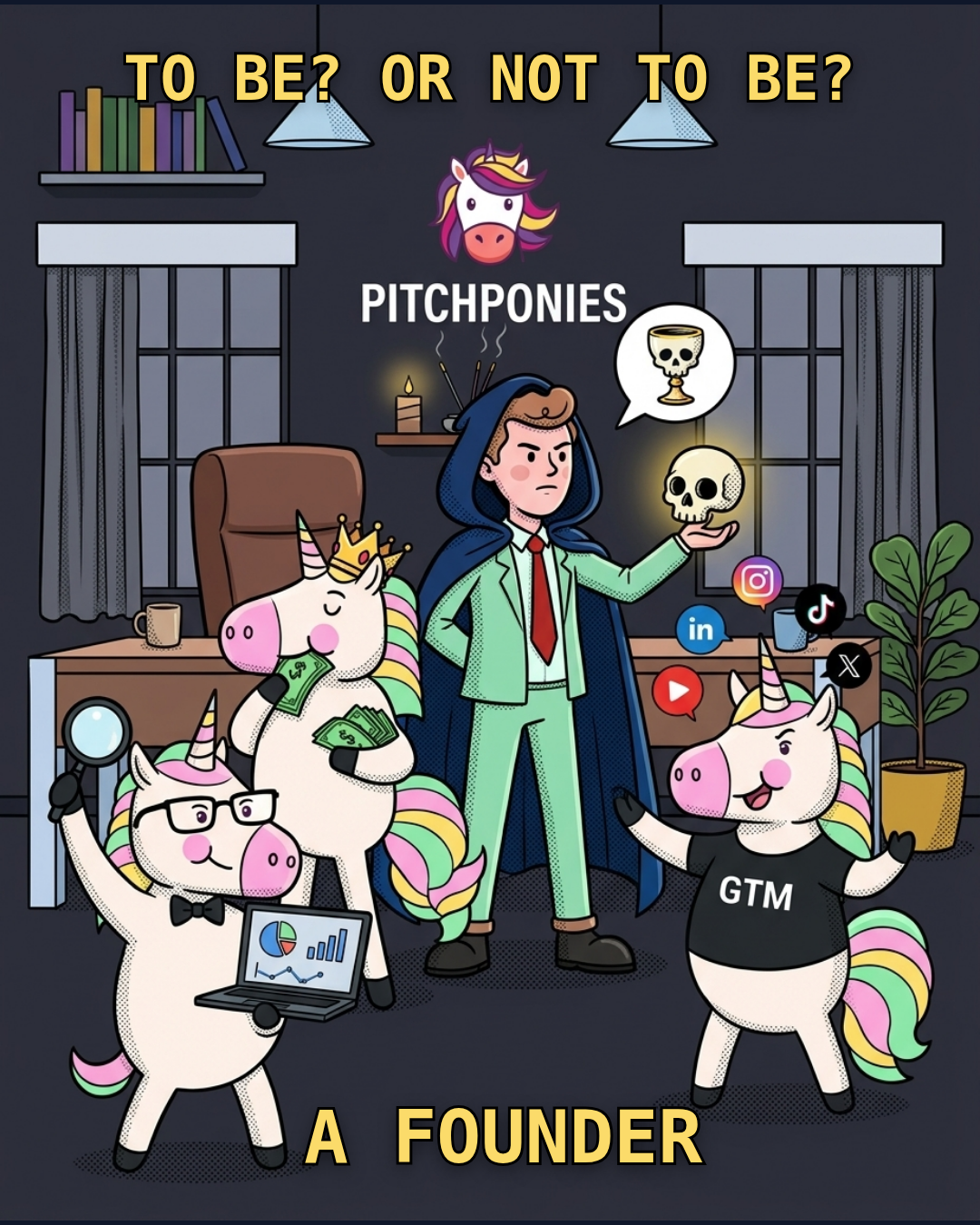
The article you didn't know you're living inside
Somewhere between filing the paperwork and pitching your first deck, something quiet happens. People stop asking what you're building and start asking who you are. And almost without noticing, you start answering in kind. You become not just someone who founded a thing, but the founder of the thing. One word. One tiny article. Enormous consequences.
The difference between a founder and the founder isn't grammar. It's a whole identity architecture. And most people stumble into the second version without ever choosing it.
The article doing all the work (and it's not the one in your pitch deck)
Here's the thing about the English definite article. It's one of the shortest words in the language and one of the most loaded. A is democratic. Ordinary. It means one among many. The is singular. Appointed. Inevitable.
When you're a founder, you're playing a role. You built something, you wear the hat, but the hat stays on the hook when you leave the office. You're the person doing the founding. When you're the founder, the hat is stapled to your head. You become the story the company tells about itself, the mythology baked into the homepage, the reason investors take the meeting, the ghost in the machine long after you've stopped writing code at 2am.
Neither one is wrong. But they pull in completely different directions, and the confusion between them is where a lot of quiet damage gets done.
Most people don't choose, and that's the whole problem
The honest reality is that most people who start companies don't sit down and consciously decide which version of the founder they want to be. They solve a problem, they recruit someone, they raise a bit of money, and suddenly the company has a mythos and they're at the center of it.
Media and investor narratives tend to frame the founders who rise to the top of public consciousness as exceptional from the start — geniuses with rare insight, elite credentials, revolutionary ideas, and a near-mythical ability to endure pressure others cannot. That framing feels like praise. It is also a trap, and it tends to arrive before you've had a chance to opt in or out.
When you absorb the mythology unreflectively, it starts making decisions for you. You don't fire the early employee you should fire because the founder is loyal. You don't take outside feedback well because the founder has vision others can't see. You don't hand off the product because the founder built this thing with their bare hands. None of these are conscious choices. They're just the gravity of an identity you never technically agreed to.
Research on founder psychology suggests that identity is an often-overlooked element in popular founder advice — and that many founders unconsciously merge their self-worth with business performance. That merger doesn't show up on the cap table, but it shapes almost every decision that does.
What 'the founder' actually does to your judgment
Founding a company and becoming the founder are two different jobs. The first is operational. The second is narrative. And when you conflate them, you start running narrative logic on operational problems.
Consider how this plays out in board meetings. A founder asks, "does this decision serve the company?" The founder asks, unconsciously, "does this decision serve the story?" Those two questions don't always have the same answer. In fact, they often don't.
Founders can have difficulty making decisions that benefit the organization because of their deep affiliation with it. In some cases, the founder — usually the CEO or managing director — is subject to HiPPO (Highest-paid-person's opinion) dynamics, originally identified in data and analytics contexts, which can mean their ideas and decisions win out over alternative approaches that may serve the organization better. This isn't about ego in the pejorative sense. It's what happens when an identity gets load-bearing. When who you are is tied to what the company is, any challenge to the company reads as a challenge to you. So you defend. Even when you shouldn't.
Pouring yourself into your company creates an identity exchange that can warp decisions, stunt growth, and make healthy exits significantly harder. That's not a character flaw. It's what happens when you skip the step of consciously deciding who you're being.
When the mythology is a superpower
None of this means founder mythology is bad. It isn't. At the right moment, in the right dose, it can be a significant advantage.
Early-stage companies don't have much to sell except a story and a person. The founder's name, conviction, and willingness to stake their identity on an idea is often what gets customers to take a chance, what gets early hires to leave safer jobs, what gets investors to write a check when the data is thin. The mythology earns its keep.
The argument is that a strong mythos helps people understand why you exist, what changed, and why they should care. Founders are often the most credible vessel for that story, at least at the start. Customers buy conviction. Investors fund belief. The the is doing real commercial work in those moments.
Business framed as a skill to be developed through practice, rather than as a test of identity or endurance, might be more sustainable in the long run, but some early-stage investors may find the mythology more compelling — though investor preferences vary widely, and learning agility and self-awareness are increasingly valued at the pre-seed stage too.
The golden cage problem
Here's where it gets complicated. The mythology that launches you can also lock you in.
As a company scales, the founder-as-story becomes progressively harder to maintain and progressively more expensive to cling to. The decisions a company needs at series B are different from the ones it needed on day one. Hiring, delegation, culture design, board dynamics, eventually succession. These are all domains where the founder identity, that singular, mythologized, irreplaceable version of you, actively gets in the way.
One perspective holds that the "Founder Era" — a term used in some investor and management circles to describe periods of outsized founder influence — isn't dead, but is evolving: the founder is now the spark, not the fuel. Though it is worth noting that the question of when founders should step back from operational leadership remains genuinely contested in current research and practice. That's a generous framing of something harder: eventually, the company needs to run on something other than you, and if your identity is fully merged with the company, that handoff feels like an amputation.
How to recognize when a successful founder-CEO should exit or be replaced is a real question that serious researchers spend serious time on. Academic work on founder succession — including research by Noam Wasserman and others — identifies multiple contributing factors: board dynamics, company stage, market conditions, investor pressure, and capability gaps, among them. Identity separation is often one relevant dimension, though rarely the sole determinant.
Ironically, the founders who cling hardest to the mythology are often the ones who built something real enough to outgrow them. That's not a failure. That's just scale. But it only feels okay if you'd already chosen to be a founder, not irreversibly the founder.
The underrated strategic move nobody mentions
Every conversation about founder strategy covers things like product-market fit, fundraising sequencing, hiring frameworks, go-to-market timing. Almost none of them cover the foundational question underneath all of those: who are you choosing to be in relation to this company?
That question sounds soft. It isn't. Emerging research on founder psychology suggests that founders who separate identity from performance — who view the company as something they build, not something they are — tend to demonstrate clearer thinking, stronger leadership, and more resilient recovery from setbacks, though this remains an active area of study rather than settled consensus.
Choosing to be a founder, consciously, doesn't mean caring less. It doesn't mean refusing the mythology when it serves you. It means holding it deliberately, wearing it when it's useful and taking it off when it isn't. It means you can let the product change direction without feeling like you're betraying yourself. It means you can hear hard feedback about the business without hearing it as hard feedback about you as a person. It means you can eventually design an exit, a transition, a new chapter, without it feeling like an identity collapse.
Some researchers argue that founder psychology emphasizing adaptability over perfection matters here — and that founders who continuously evolve their mental models may tend to outperform, by measures such as company longevity and exit quality, those who cling to outdated identities, though the evidence base for this is still developing.
And the flip side is equally true. If you want to lean into the mythology, lean in deliberately. Know that you're doing it. Know what it costs. Know when the return on it starts to diminish. Use it as a tool, not as a crutch you don't realize you're leaning on.
One article, many outcomes
There's a version of this essay that ends with a clean framework, a 2x2, some bullet points, a step-by-step guide to picking your founder archetype. But that would miss the point.
The whole argument is that the choosing matters more than what you choose. Most builders skip the choosing entirely. They get swept up in building, then swept up in the narrative others build around them, then suddenly find themselves playing a character they never auditioned for, wondering why every decision feels heavier than it should.
So here's the provocation, and it's a simple one. Before the next fundraise, the next hire, the next pivot, ask yourself which version of the founder you've been operating as. Not as a criticism. Just as information.
Because if you know who you're being, you can decide whether that's who you want to be. And that, quietly, changes everything.

Pitch Ponies
Your go-to-market function, from week one.
Your go-to-market function, from week one.
Learn more about Pitch Ponies and get started today.
Visit Pitch Ponies