Turn On, Tune In, Start Up: The Psychology of Beginning
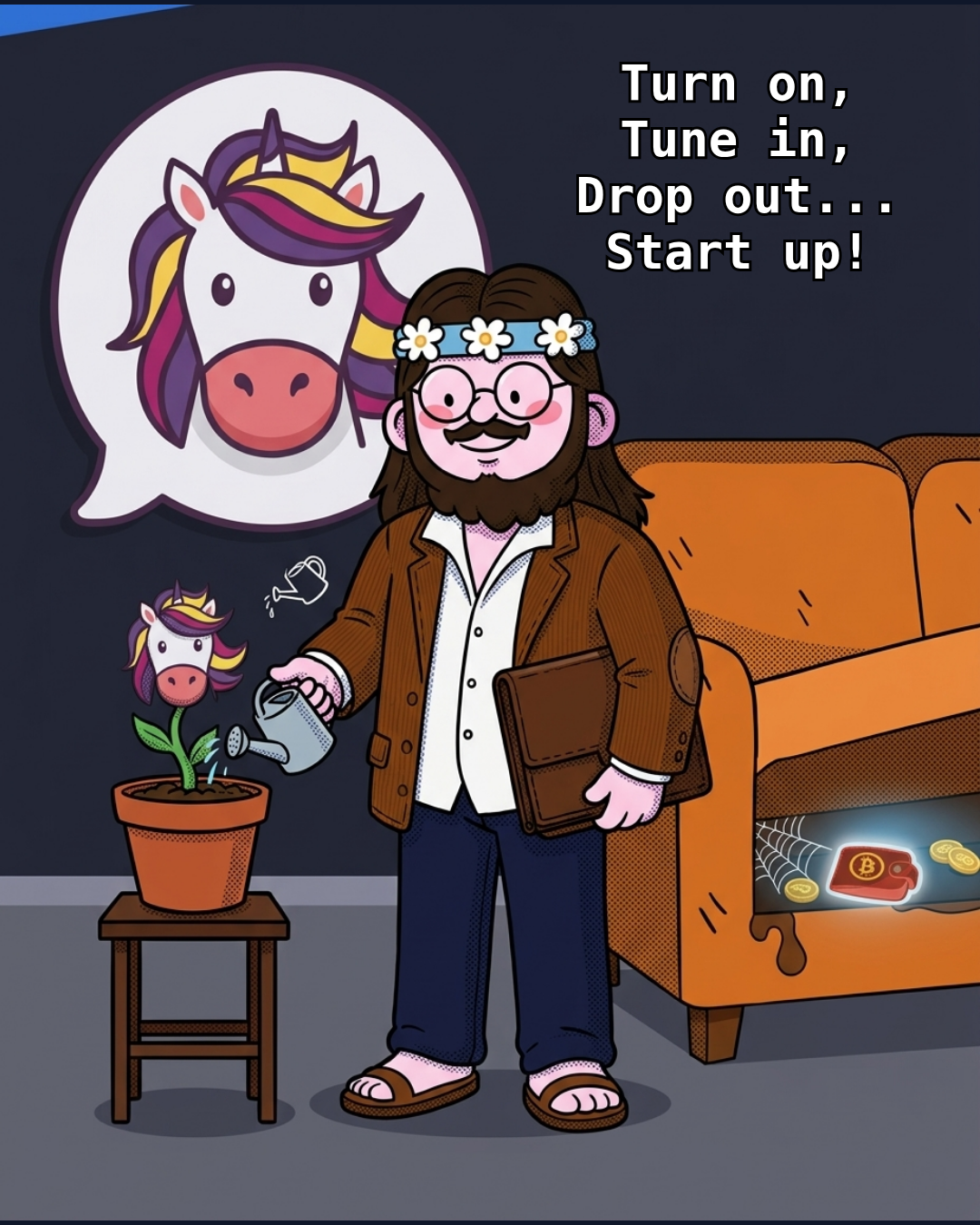
Turn On, Tune In, Start Up: The Psychology of Beginning
There is a particular electricity that exists in the moment just before something begins. A hand hovering over a keyboard. A breath held before the first word is spoken. A founder staring at a blank business plan at 11 p.m. That moment, the one right before the turn, carries more psychological weight than most of us give it credit for. The act of beginning isn't just a logistical event. It's a neurological one. And understanding what actually happens when we start can change how we start, and whether we stick.
The phrase turn on, tune in, start up sounds deceptively simple, almost like a checklist. But each word does something distinct. They represent a sequence that, when honored in order, can create something most people chase but rarely manufacture on demand: genuine momentum.
Turn On: The Charge That Changes Everything
Every meaningful beginning starts with a charge, some internal shift that says now. Psychologists have a name for the moment that creates the conditions for this shift. The start of something new acts as what researchers call a "temporal landmark," a moment that separates our older selves from the people we hope to become. These aren't manufactured experiences. They're felt ones. And the feeling matters enormously.
Behavioral science research has found that landmarks create a "fresh start effect": people feel more motivated to pursue aspirational goals simply because a new chapter seems to be opening. But here's what the research also makes clear: the charge of beginning is real, but it's fragile. We often mistake the emotional lift of beginning something new for motivation that will last.
So what separates a true ignition from a false start? It comes down to what the turn-on is actually connected to. Self-Determination Theory, developed by psychologists Edward Deci and Richard Ryan, is an established framework in motivation research suggesting motivation is sustained when goals support three psychological needs: autonomy (feeling the goal is genuinely ours), competence (feeling capable of progress), and relatedness (feeling supported).
In other words, turning on isn't just about feeling excited. It's about feeling chosen. The spark has to come from inside the engine, not from someone else's ignition key.
When this happens, something can follow. Some neuroscientists hypothesize that when we enter a flow state, the prefrontal cortex, responsible for self-awareness and judgment, quiets down — a proposed mechanism known as transient hypofrontality — allowing other brain regions to synchronize and work harmoniously, while neurochemicals like dopamine may enhance motivation and creativity. These are proposed mechanisms under ongoing study rather than settled science. That is one description of turning on fully: not just an idea, but a whole-body readiness.
Tune In: The Bridge Between Intention and Action
Most people skip this part. They turn on, feel the surge, and immediately sprint toward action. But tuning in is the step that determines whether the momentum you build is real or borrowed.
Tuning in means reading the environment honestly. It means sitting still long enough to notice what signals are already present before you add more noise. A flow state of mind spontaneously arises when we become immersed in an activity so completely that we lose track of time, and it has similarities with mindfulness because it requires focus in the present moment. But getting to that state requires a willingness to slow down first.
This isn't passivity. It's precision. A surgeon tunes in before the first incision. A musician tuning in isn't wasting time, they're earning time. The subtle signals available in any present moment, your energy level, the texture of your resistance, what you're genuinely drawn toward today rather than what you planned yesterday, contain information that grand intentions often ignore.
Stating your intention clearly to yourself, being specific about what you're about to do and why, is one of the first acts of tuning in. It sounds obvious. It rarely gets done. Most people begin with a vague orientation rather than a precise one, and then wonder why things feel foggy.
Flow doesn't respond to vague intentions. When you define a clear, concrete goal, your brain knows what done looks like. Progress becomes measurable, which creates its own motivation.
Tuning in is also about reading resistance honestly rather than suppressing it. The writer who sits at a blank page and notices panic rather than denying it is already ahead. That noticing is information. It tells you where to begin: not at the intimidating place, but at the reachable one.
Start Up: The Ritual of Deliberate Small Steps
Here is the part that most cultural narratives get spectacularly wrong. Starting up is not a leap. It is not a declaration. It is not one brave, cinematic moment.
Action generates motivation, and motivation fuels further action. When you wait for motivation before acting, the cycle never begins. When you act first, no matter how small, you spark the cycle into existence.
This is the insight hidden in plain sight. You don't need to feel ready. You need to begin. And the beginning doesn't need to be dramatic.
Behavioral momentum is a principle that describes how living beings build an inclination to continue a course of action. It begins with the successful completion of a few simple, familiar tasks. Accomplishing these initial steps creates a psychological current that carries you forward, making it more probable that you will attempt and complete a more challenging task next.
Think about what this means practically. The novelist who writes one honest sentence has already broken the gravitational pull of the blank page. The entrepreneur who sends one email, not the pitch deck, not the fundraising round, but one real email, has already started a company. The blank page feels intimidating, but writing even one rough sentence can lead to a flood of ideas. The act of beginning removes the psychological weight and creates motion that feeds on itself.
A flow state ritual is an action, or series of actions, you take every time you're about to start working on a critical task. This action is a signal to both your brain and your body that you're about to give all your focus and attention to one task, and that you won't allow anything to distract you. This ritual helps put you in the single-track mindset required to enter the flow state.
The word ritual matters here. A ritual implies repetition. Repetition implies intention. And intention, repeated enough times, becomes identity. The real transformation isn't just the accumulated actions; it's who you become through the process. Consistent micro-wins build confidence. You prove to yourself, daily, that you follow through, and this identity shift can create a growth mindset that extends beyond your original goal.
Small steps don't just add up. They can accumulate into outsized results over time. The real power of momentum lies in how small consistent actions can compound — building on one another in ways that produce results larger than any single effort would suggest.
Edison, a famously prolific inventor, knew this. He didn't wake up one morning and invent the light bulb. A sentiment often attributed to him — though the exact wording is disputed — captures something true about his method: that each failed experiment brought him closer to the result, because each one was a step in the process necessary to arrive at success.
The Sequence Matters: Awareness, Alignment, Ignition
The three-part phrase isn't decorative. It describes a genuine sequence, and skipping steps costs you more time than honoring them.
Awareness comes first. You have to turn on, to notice that something in you is ready, willing, or simply done with waiting. This isn't always a euphoric feeling. Sometimes it's quiet. Sometimes it arrives as a low, persistent discomfort with where you currently are.
Alignment comes second. This is the tuning-in phase. You listen to what's available, what you actually have access to today, and you align your intention with the current reality rather than the ideal one. Accessing a true state of readiness is about creating that perfect alignment between your skills and the challenge at hand, and immersing yourself fully in the moment.
Ignition comes third, and only third. When goals are shaped by vague aspiration or unrealistic scope, and when early effort doesn't translate into visible progress, competence falters and motivation follows. That's what happens when people skip awareness and alignment and leap straight to action. They're starting without direction. They're lighting a match in the wind.
When all three arrive in order, something clicks. Flow is the moment when action and awareness merge. Psychologist Mihaly Csikszentmihalyi, who first described and named flow states, placed this convergence at the heart of the experience: the internal negotiation stops, work feels earned rather than forced, and you're not pushing against resistance — you're moving with it.
Momentum isn't magic or motivation; it's evidence. Each small action that delivers a result gives your brain proof that progress is happening. That proof builds belief. And belief is what drives consistency.
Every Great Beginning Started With One Person
History doesn't begin with movements. It begins with moments. Every civil rights act, every scientific breakthrough, every work of art that altered how a generation understood itself, traces back to one person who decided, quietly and without any guarantee of success, to begin.
Rosa Parks — herself a trained civil rights activist and NAACP secretary — made a deliberate choice that ignited a broader, long-organized movement. Her act of staying seated was both profoundly courageous and part of a strategically coordinated effort, which makes it no less powerful as an example of individual will meeting collective purpose. Watson and Crick's decoding of DNA's structure drew on a wide range of scientific contributions, including crucially the X-ray crystallography work of Rosalind Franklin — a reminder that even landmark breakthroughs rarely emerge from isolation alone. Marie Curie, the first person to win Nobel Prizes in two separate sciences, persisted through extraordinary institutional barriers over decades of exacting work. Each of them, at some point, simply turned to the work.
This is not a small thing. The willingness to begin, without certainty, without momentum already in place, without proof that it will work, is the foundational act of every transformation the world has ever seen. The first step is never wasted, even when it leads sideways. Especially then.
Success isn't typically the result of a single, monumental effort but rather the outcome of small, consistent actions compounded over time. But those small actions still have to start somewhere. They still need a first one.
If you're waiting for the moment to feel right, consider the possibility that it already does, and you're simply not listening closely enough. Turn on. Tune in. Start up.
The only moment that was ever available to you is this one.
Note: Citations throughout this article reference an internal source index. A full reference list keyed to those index numbers is available here. Readers are encouraged to consult the primary sources directly to verify any claims of interest.

Pitch Ponies
Your go-to-market function, from week one.
Your go-to-market function, from week one.
Learn more about Pitch Ponies and get started today.
Visit Pitch Ponies